Asfura Government Withholds Key Details of Chinese Solar Megaproject Amid Transparency Concerns
* Two institutions within the Asfura administration denied Expediente Público access to agreements with the Chinese company Danasun for the Choloma project. * The National Electric Power Company (ENEE) said the documents should be provided by the Ministry of Energy, which in turn stated it does not have the information. * Experts warn that placing…
* Two institutions within the Asfura administration denied Expediente Público access to agreements with the Chinese company Danasun for the Choloma project.
* The National Electric Power Company (ENEE) said the documents should be provided by the Ministry of Energy, which in turn stated it does not have the information.
* Experts warn that placing critical infrastructure in the hands of Chinese companies could affect Honduras’s relationship with the United States.
Yarely Madrid / Expediente Público
The government of President Nasry Asfura is promoting a US$400 million Chinese-backed solar megaproject while withholding key information about the agreements underpinning it, raising transparency concerns over one of Honduras’s largest renewable energy investments.
Two institutions within the administration denied Expediente Público access to the contracts signed with the Chinese company Danasun Energy for the Choloma solar park. The National Electric Power Company (ENEE) redirected the request to the Ministry of Energy (SEN), while the Ministry responded that it does not possess the documents.
This institutional contradiction prevents public scrutiny of the project and leaves unanswered questions about its financial structure, contractual terms, and potential state involvement.
Subscribe to the Public Record newsletter and receive more information
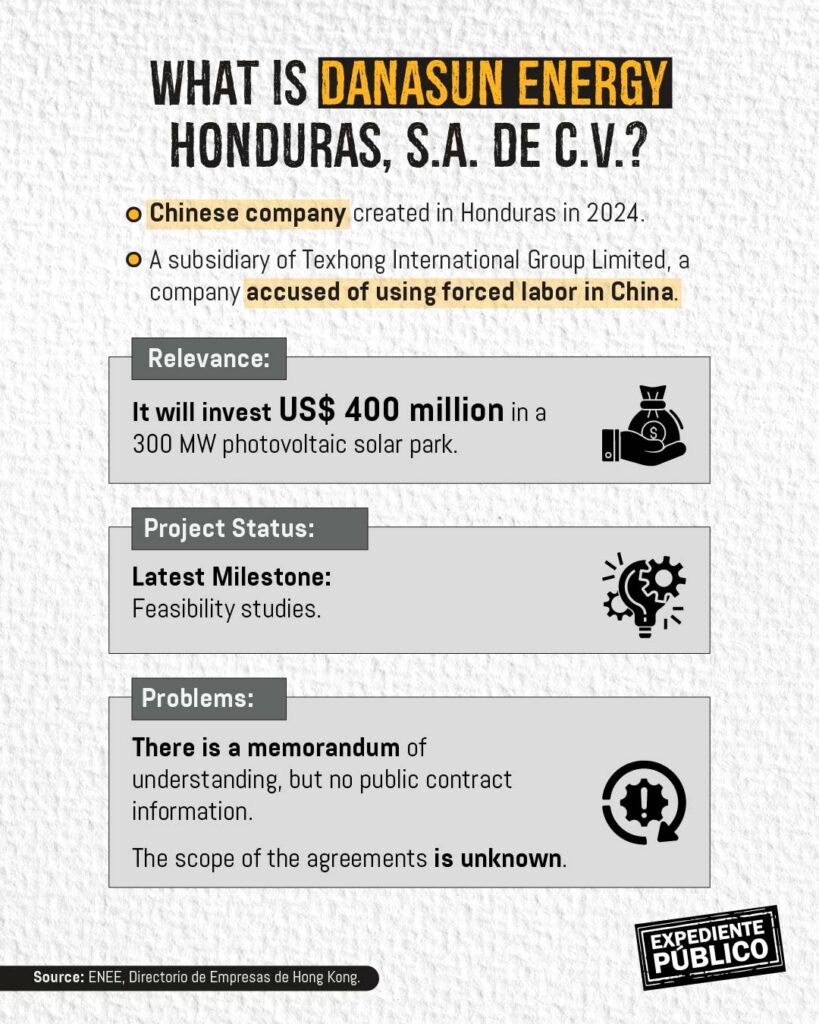
The project is being developed by Danasun Energy Honduras S.A. de C.V., a subsidiary of the Chinese textile conglomerate Texhong International Group Ltd., and has been presented by authorities as a key step in expanding renewable energy capacity.
At the same time, President Asfura has highlighted his meetings with U.S. President Donald Trump, as Washington seeks stronger regional alignment to curb China’s influence, particularly in strategic sectors such as energy infrastructure.
Experts consulted by Expediente Público warn that advancing a project of this scale under opaque conditions sends a negative signal to Honduras’s strategic partners.
Conflicting Accounts and Limited Transparency
Despite publicly promoting the continuation of the project, ENEE declined to provide documentation and referred the request elsewhere. The Ministry of Energy’s claim that it does not hold the agreements deepens concerns about accountability.
Without access to the contracts, it remains unclear under what terms the plant will operate, whether the State has any financial participation, or if the project could generate future fiscal liabilities.
It is also unknown whether the electricity produced will supply Texhong’s textile operations in Choloma or be sold to the State, and under what pricing mechanisms.
Corporate Structure and Background
Danasun Energy Hong Kong Limited was incorporated on February 2, 2024, as a private company limited by shares, according to the Hong Kong Companies Registry.
The firm is part of Texhong International Group, a Chinese conglomerate with operations in multiple countries and corporate registration in the Cayman Islands, a known tax haven.
Investigations by Expediente Público have linked Texhong to international allegations of forced labor practices in China.
In Honduras, another subsidiary, Winnitex, established a textile facility in Choloma in 2024, reinforcing Texhong’s growing presence in the country.
See also: Empresa acusada internacionalmente de utilizar trabajo forzado se instala en Honduras
Investment Model and Open Questions
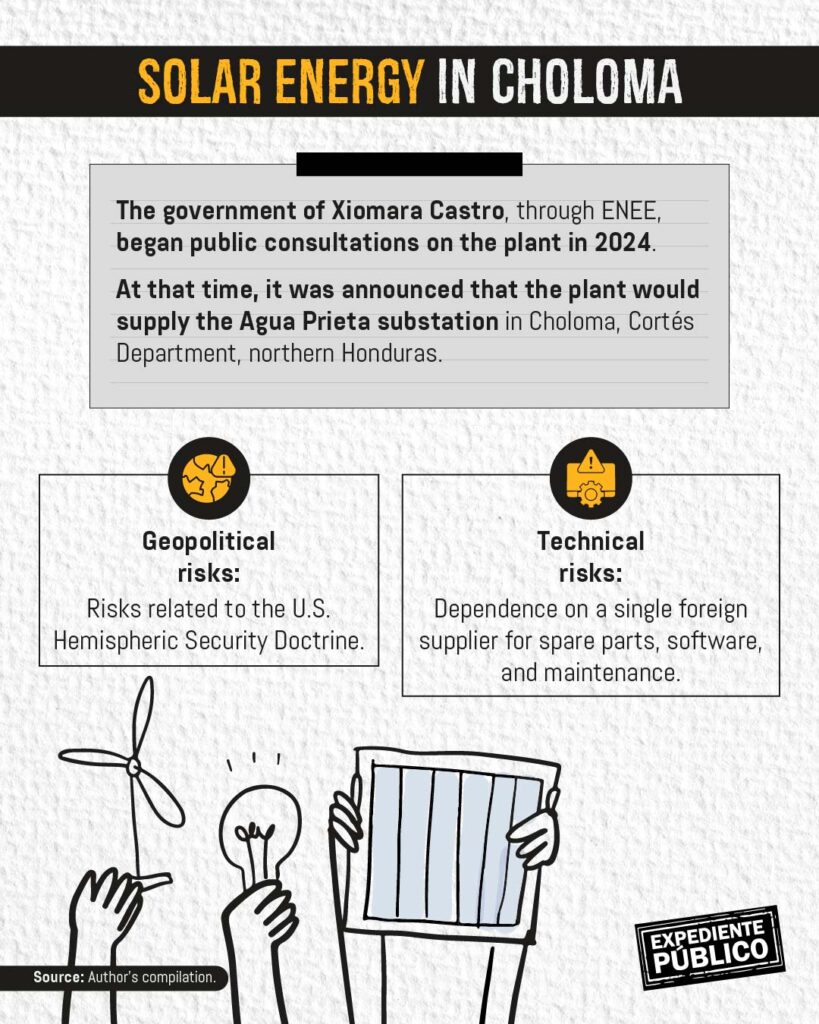
The solar project originated during the administration of Xiomara Castro and was initially linked to supplying the Agua Prieta substation.
However, there is no public evidence that the Honduran State is investing in the project. Current indications suggest it is structured as a private investment by Danasun.
While it could serve Texhong’s industrial operations, the plant’s projected capacity—300 MW with 60 MW of battery storage—far exceeds the needs of a single facility, suggesting broader commercial objectives.
One scenario under consideration is that the plant could operate without a long-term Power Purchase Agreement (PPA), selling electricity on the spot market. Under this model, energy is injected into the national grid and sold based on real-time demand, without long-term contractual guarantees.
Energy expert Kevin Rodríguez questioned the financial viability of a US$400 million investment without certainty regarding buyers.
He warned that, in the event of financial stress, the investor could seek to secure direct and potentially onerous contracts with ENEE, a practice that has historically distorted Honduras’s energy market and strained public finances.
Related: Honduras negocia proyectos portuarios con empresa china salpicada por corrupción a nivel mundial
Regulatory Process and Oversight Gaps
The project remains in an administrative phase and has not yet reached the construction stage.
In September 2025, Danasun’s general manager in Honduras, Chuanxi Fang, initiated the process to solicit bids for the Environmental Impact Assessment (EIA) before the Ministry of Natural Resources and Environment (SERNA), under the project names “Light I” and “Light II.”
The project must comply with multiple regulatory requirements, including environmental classification, registration as a power generator with the Energy Regulatory Commission (CREE), and grid impact studies coordinated by the National Dispatch Center.
These steps are designed to ensure system stability and environmental sustainability. However, the absence of publicly available agreements raises concerns about the effectiveness of oversight mechanisms.
Additionally, the company is expected to seek tax incentives under the Law for the Promotion of Renewable Energy Generation. Without exemptions from the Ministry of Finance (SEFIN), imports of key equipment would be subject to a 15% sales tax, significantly affecting project costs.
Precedents and Risk Factors
Honduras has previously faced disputes involving Chinese companies in the energy sector.
In May 2024, China Energy Engineering Corporation filed a claim against the Honduran State for approximately US$125 million related to a contract dispute involving thermal power plants.
Another company, Sinohydro, has been linked to allegations of cost overruns, technical deficiencies, and corruption in the Patuca III hydroelectric project.
These precedents raise concerns about governance, contract enforcement, and long-term financial exposure.
Geopolitical Implications
From an international perspective, analyst Graco Pérez warned that placing critical infrastructure in the hands of Chinese companies could have geopolitical consequences.
“We are heavily dependent on the United States, which gives it multiple avenues to exert pressure on the country,” Pérez stated.
He noted that Asfura had previously suggested reviewing relations with China and potentially restoring ties with Taiwan, aligning more closely with U.S. foreign policy.
According to Pérez, increased Chinese investment in strategic sectors such as energy, infrastructure, and telecommunications could lead Washington to view Honduras as an unreliable partner.
He also emphasized that trade policy remains a key tool of pressure, noting that Honduras still faces tariffs that other countries in the region have already eliminated.