Without the ONU, Bukele Takes on Haiti’s Gangs
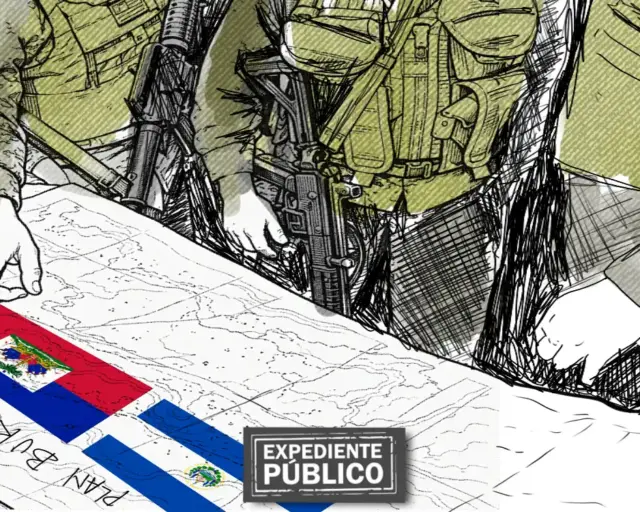
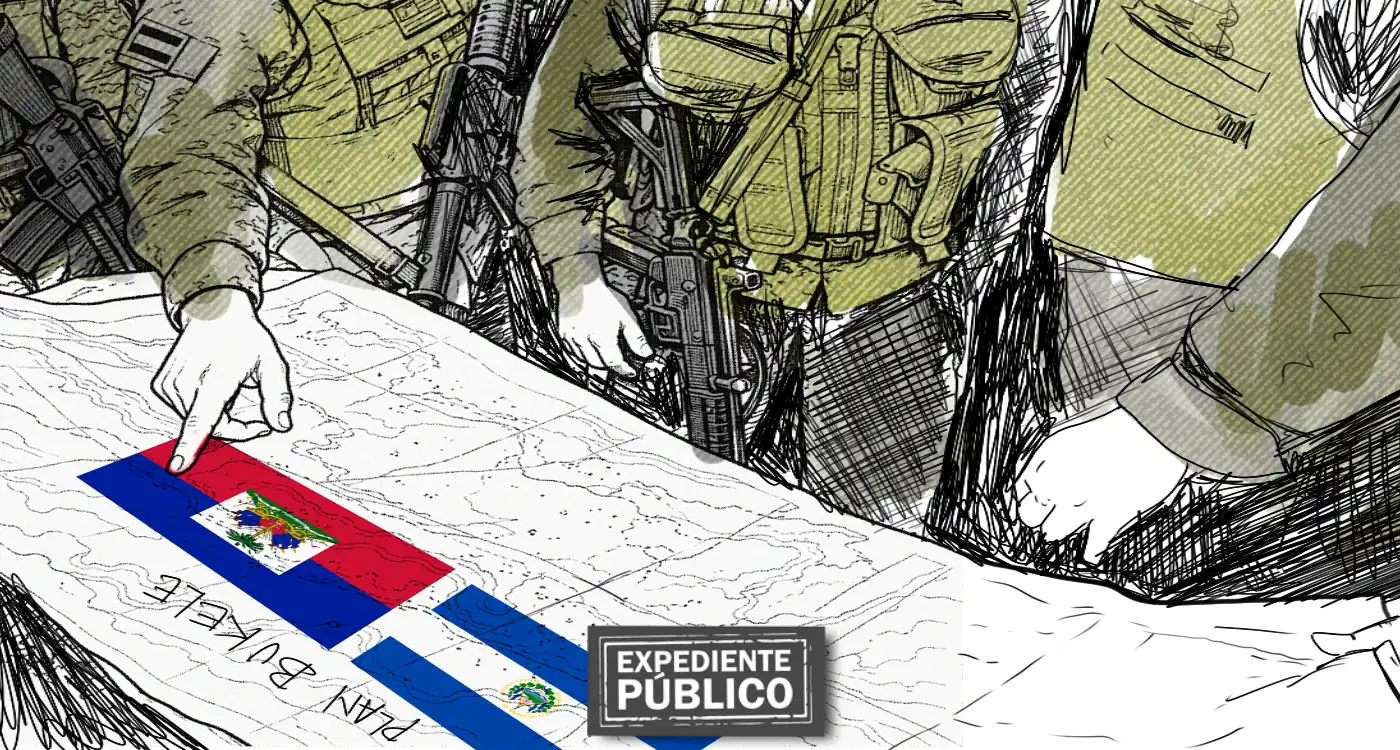
The vast majority of the more than 2,000 troops Bukele sent to Haiti are operating outside the UN-authorized force. Although the deployment has the Haitian government’s consent and is grounded in Salvadoran law, the terms of the bilateral agreement have not been made public.
Jéssica Guzmán
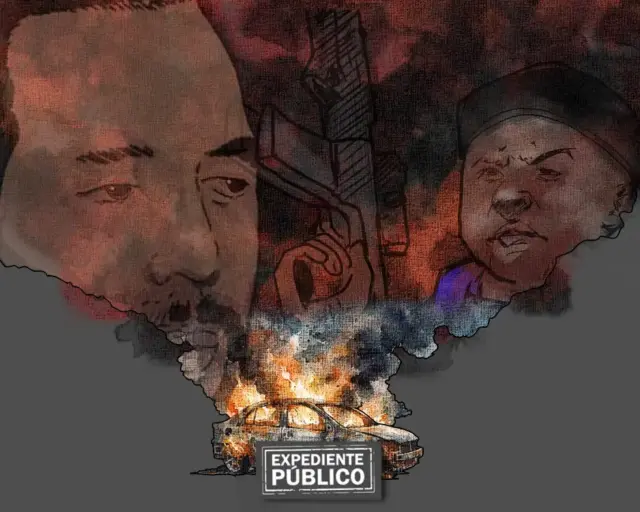
Haiti, Sunday, October 18, 2026. Four Salvadoran military technicians, whose identities have not been officially disclosed, went missing following an ambush by armed groups in Santo, in the commune of Croix-des-Bouquets, northeast of the capital, Port-au-Prince.
The service members were returning to their camp when gunmen attacked them. Their vehicle was set on fire, and their whereabouts have remained unknown ever since.
Three days later, El Salvador’s president, Nayib Bukele, issued a message to Haiti’s gangs. In a post on X, he emphasized that the four missing personnel were not combat troops but aviation specialists whose primary task was to carry out medical evacuations and save lives.
The president also announced a military operation to rescue them. “We have only one objective: to bring our four compatriots home alive and unharmed,” he wrote.
Subscribe to the Expediente Público newsletter for more reporting
Bukele’s Military Escalation
Bukele also issued a direct warning to Haiti’s gang leaders, the suspected kidnappers of the Salvadoran technicians.
“Do not take our words as empty threats. We have already put an end to the gangs in El Salvador, and we can put an end to yours as well,” he wrote.
The president accompanied the offensive with religious rhetoric, portraying the operation as a mission backed by God.
In context: Nayib Bukele seeks a third term by controlling elections
He also described Haiti’s gangs as “satanic” and cited a Bible verse about the defeat of one’s enemies: “The Lord will cause your enemies who rise against you to be defeated before you.” “God will grant us victory. The Creator of the Universe is with us,” he declared.
What began as a mission to provide technical support and medical evacuations evolved into a much broader military intervention. El Salvador announced the deployment of more than 2,000 personnel to Haitian territory, citing the need to rescue the four missing service members and intensify the offensive against criminal organizations.
The scale of the deployment, and the participation of Salvadoran forces outside the framework of the UN-backed international security mission, raise questions about the intervention’s scope, its rules of engagement and who exercises control over the operations.
It is the largest military deployment by a single country in Haiti since the withdrawal of the military component of the United Nations Stabilization Mission in Haiti (MINUSTAH) in October 2017.
From a Medical Mission to a Military Intervention
What were Salvadoran troops initially doing in Haiti?
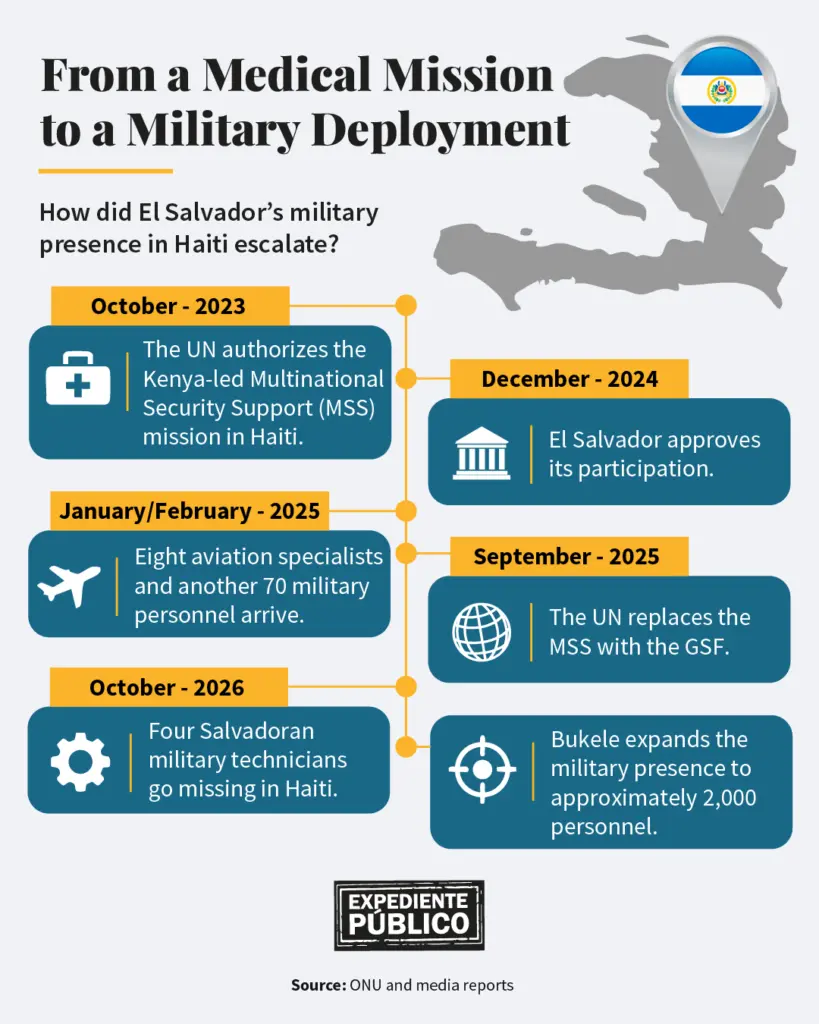
In October 2023, the United Nations Security Council authorized the creation of the Multinational Security Support Mission (MSS), a Kenya-led force intended to support the Haitian National Police against the expansion of gangs. The first contingent, consisting of 200 Kenyan police officers, arrived in the country in June 2024.
On December 20, 2024, El Salvador’s Legislative Assembly approved the Special Law on the Participation of the Armed Forces in the MSS. The law authorized the deployment of Salvadoran military personnel and aviation capabilities to support the mission’s operations.
Also read: Nayib Bukele: Four and a half years of governing under a state of exception
In January 2025, El Salvador began its military deployment in Haiti with the arrival of eight aviation specialists. On February 4, 2025, another contingent of 70 personnel arrived, tasked with providing air support and carrying out medical evacuations.
Several months later, on September 30, 2025, the UN Security Council adopted Resolution 2793, authorizing the transition from the MSS to the Gang Suppression Force (GSF).
The new mechanism expanded the international force’s operational capacity to conduct operations against criminal organizations in coordination with Haitian authorities.
On September 29, 2026, El Salvador’s Legislative Assembly approved a new law authorizing the Armed Forces to participate in the GSF.
But the deployment took on a new dimension after the four military technicians disappeared. In late October, Bukele announced that more than 2,000 troops and military equipment would be sent to Haiti. According to subsequent media reports, the contingent may have grown to approximately 2,500 personnel.
However, the lack of detailed official information makes it impossible to establish with certainty how many troops have been deployed.
Haiti and Washington Respond to Bukele’s Offensive
The military deployment was discussed in an October 28 phone call between Bukele and Haitian Prime Minister Alix Didier Fils-Aimé. According to a statement from El Salvador’s Foreign Ministry, the two leaders agreed to strengthen bilateral coordination and operational cooperation on security matters.
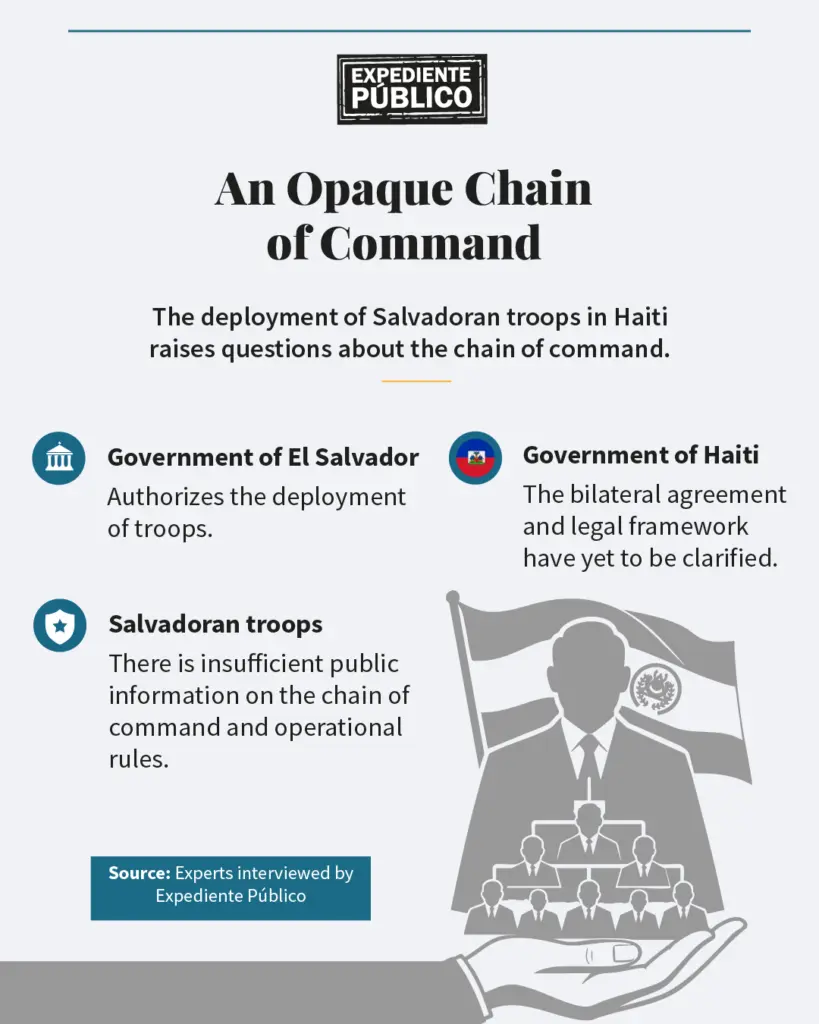
However, the terms of any agreement setting out the conditions, scope and chain of command of the Salvadoran personnel have not been made public.
The intervention also received political backing from U.S. President Donald Trump. After speaking by phone with Bukele about the situation in Haiti, Trump said on October 31 that he had told Bukele: “You run your country; you have to do what you have to do.” Bukele later reposted Trump’s remarks on X and replied: “Can confirm.”
According to an investigation by the U.S. outlet Axios, the Trump administration rejected Bukele’s requests for American military equipment, including drones and transport aircraft.
Despite those reported differences over the supply of equipment, the deployment of Salvadoran troops appears to have received U.S. logistical support. A military official confirmed to Reuters that Pentagon C-130 aircraft were involved in transporting the troops. However, the U.S. government has not officially acknowledged that support.
On November 8, 2026, Secretary of State Marco Rubio clarified that Washington was not directly involved in El Salvador’s bilateral operation.
Also read: Bukele: The U.S. ally who negotiates with China behind closed doors
The offensive also revived a proposal Bukele had put forward on March 9, 2024, when he offered to intervene to resolve Haiti’s security crisis.
“We can fix it. But we will need a UN Security Council resolution, the host country’s consent and all the mission’s expenses covered,” he wrote on X at the time, offering to intervene in Haiti’s security crisis nearly two and a half years before the four Salvadoran military technicians went missing.
Who Is Giving the Orders?
Under what rules are Salvadoran troops operating in Haiti? Who sets their objectives and oversees their operations?
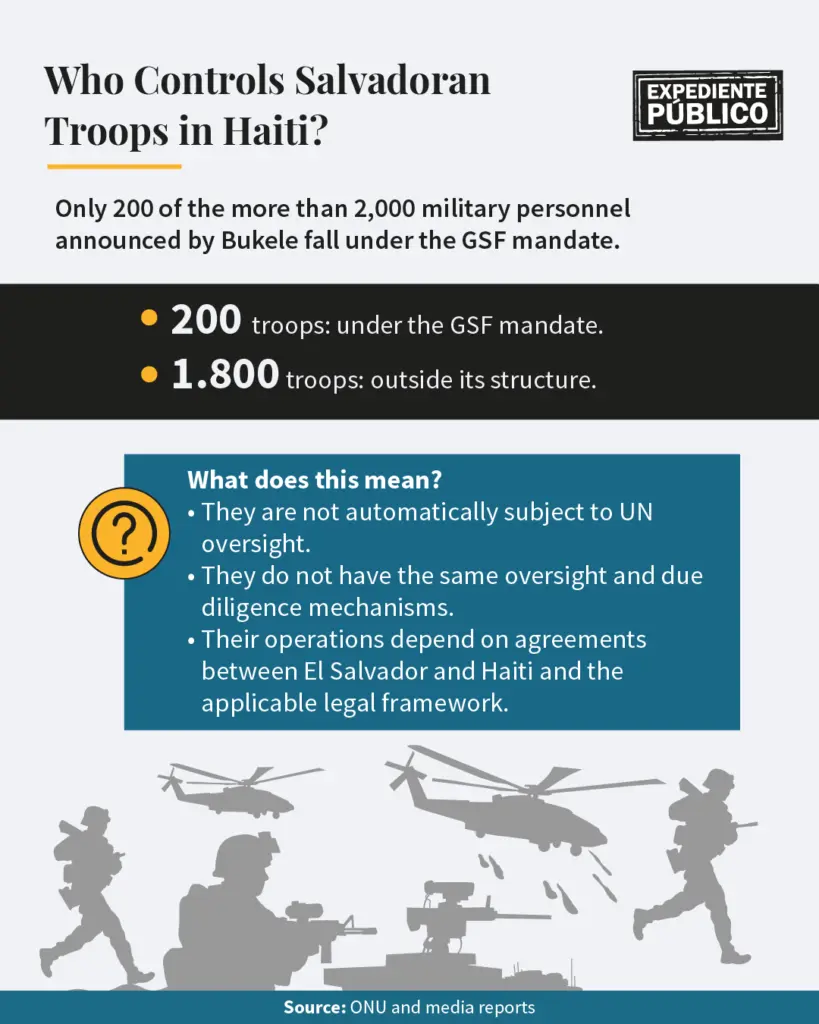
These questions became more pressing after the United Nations clarified that most of the Salvadoran personnel recently sent to Haiti were not part of the GSF.
On November 2, Stéphane Dujarric, spokesperson for the UN secretary-general, said the organization was aware of the additional deployment of Salvadoran troops to Haiti.
However, Dujarric specified that the vast majority of those personnel were not operating under the GSF framework and therefore fell outside the remit and oversight and reporting mechanisms of the United Nations Support Office in Haiti.
You may also be interested in: How real are Nayib Bukele’s achievements?
The distinction matters because the GSF has a Security Council-authorized mandate and specific mechanisms for logistical and operational support and human rights due diligence. Salvadoran personnel deployed through a bilateral arrangement are not automatically covered by those mechanisms.
In a later clarification to journalists, Dujarric said approximately 200 Salvadoran personnel were covered by the GSF mandate. This means that most of the additional contingent operates outside that international framework.
Expediente Público spoke with Argentine military officer Julio Theaux, a former member of MINUSTAH who served as a battalion logistics officer between 2006 and 2007 and is now regional executive director for South America at Roca Defense & Systems.
Drawing on his experience, Theaux warns that there is a gap surrounding the rules governing Salvadoran troops’ conduct.
“There is something of a vacuum in that regard, because the United Nations has already stated [that] the deployment does not fall under its authority; so the only thing left is direct contact between the governments of Haiti and El Salvador for the deployment of forces,” he explains.
“Since they are not operating under a United Nations mandate or within the GSF, the reality is that they will be subject to the laws established by the Haitian government. It is complicated: they need to interpret Haiti’s laws correctly and be clear about how they will operate,” he warns.
The specialist also questions the lack of public information about the terms of the understanding between the two governments and the conditions governing the actions of Salvadoran troops.
U.S. Secretary of State Marco Rubio also stressed the need to establish a clear chain of command and coordination mechanisms among the various forces deployed in Haiti.
“We have to make sure the chain of command is clearly established, who answers to whom,” Rubio told reporters at Homestead Air Reserve Base in Florida on November 8.
Have Violence and Insecurity Declined?
Amid the military escalation, another question is what is happening to Haiti’s civilian population.
María Fernanda Arocha, research manager for Central America and the Caribbean at the Armed Conflict Location & Event Data Project (ACLED), an international organization that monitors political violence and armed conflict, told Expediente Público that Haiti experienced two major spikes in violence, in November 2025 and October 2026, linked both to GSF operations and to clashes between gangs in Croix-des-Bouquets, Tabarre and the Cul-de-Sac Plain.
“What we have seen there are localized escalations in violence linked to security operations carried out jointly with national forces,” Arocha explains.
According to the expert, violence in those areas is tied not only to gang-suppression operations but also to disputes between rival criminal organizations in the Cul-de-Sac Plain, which have helped keep violence at high levels.
The researcher also notes that some indicators of violence have declined this year in certain parts of Port-au-Prince, but only because gangs have moved elsewhere.
“In 2025 there was an intensification of security operations. And in 2026 we see a decline, particularly in the areas where security operations have been concentrated, mainly in Port-au-Prince. But that does not mean security conditions have improved substantially, because levels of violence remain high,” Arocha says.
The organized crime and armed conflict specialist explains that gangs have also changed their strategies: they are less visible in some areas and have shifted toward territories with a weaker security-force presence.
Also read: Nayib Bukele steps up crackdown with arrests of government critics
Therefore, regaining control of certain areas does not necessarily mean that criminal organizations are being dismantled.
Another consequence of the violence is forced displacement. Clashes between gangs and security operations, “in which national, private, international and gang-suppression forces have participated,” have forced thousands of families to leave their communities and seek refuge elsewhere in the country.
According to United Nations figures, Haiti had approximately 1.5 million displaced people in 2026, Arocha recalled.
Exporting the “Bukele Model”
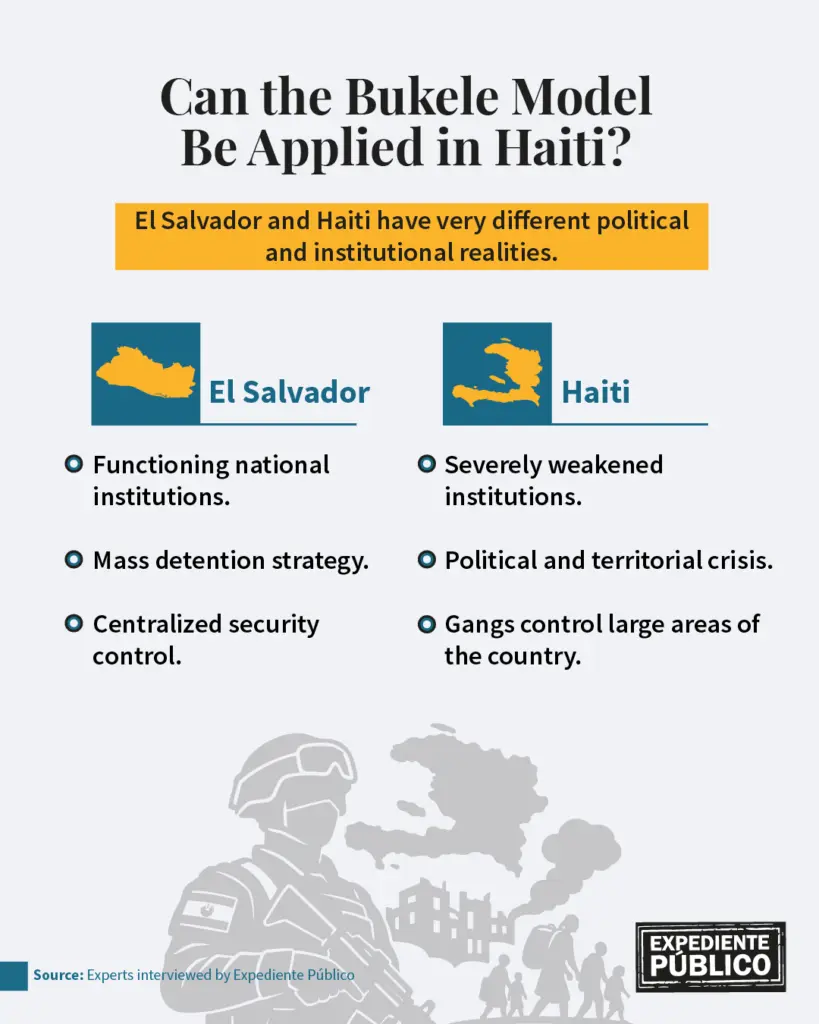
Given these conditions, is it feasible to transfer the Bukele model—based on mass arrests of gang members and the deployment of security forces—to Haiti?
ACLED’s research manager believes structural differences make comparisons between the two countries difficult. Haiti’s crisis, Arocha explains, is on a far larger scale and directly affects state institutions.
Moreover, the violence is unfolding amid a profound political crisis and weakened institutions, limiting the authorities’ ability to conduct intelligence operations and sustain a long-term security strategy.
For the ACLED specialist, it is still too early to determine whether the Salvadoran deployment will produce lasting results.
Also read: El Salvador’s mass summary trials fail to deliver justice for the disappeared
“We need to see whether it can be sustained over time, with a downward trend. Rather than interpreting this as a success, we need to see whether it signals the dismantling of the gangs or a change in how they operate,” she warns.
Expediente Público also spoke with a Haitian source who requested anonymity. According to this source, the Salvadoran deployment enjoys “popular support” among some sectors of the island’s population. The source said they were unaware of any signed agreement between the two governments.
However, any support the operation may enjoy among Haitians does not eliminate the need for transparent mechanisms of coordination, oversight and accountability for military operations.
Many Moving Parts
The experience of the Kenya-led multinational mission between 2024 and 2025 looms over this new intervention.
The multinational mission led by the African country had an authorized strength of 2,500 personnel but deployed fewer than 1,000. Despite international backing, it failed to contain the gangs’ expansion or regain control of large parts of the country.
A similar outcome would prolong the crisis, test Bukele’s efforts to take his security strategy abroad and potentially leave Salvadoran troops trapped in a conflict far more complex than his rhetoric suggests he can resolve.
As of November 16, 2026, almost a month has passed since the four Salvadoran military technicians disappeared. Their whereabouts remain unknown, and Bukele’s intervention in Haiti continues as questions persist about its limits, objectives and consequences for civilians.
The military operation also coincides with the start of El Salvador’s presidential campaign, in which Bukele will seek a third consecutive term on February 28, 2027. In that context, the outcome of the operation in Haiti will become an issue at the ballot box.