Religious Repression Marks Cuba and Nicaragua on the Global Stage
The 2026 Global Persecution Index identifies authoritarianism, terrorism, religious nationalism, and state control over religious organizations as the drivers affecting some 380 million Christians worldwide. Unlike Africa and parts of Asia, where massacres, kidnappings, and forced displacement driven by nationalist ideologies predominate, Cuba and Nicaragua apply repression that is primarily state-run, bureaucratic, and police-enforced. Previous…
The 2026 Global Persecution Index identifies authoritarianism, terrorism, religious nationalism, and state control over religious organizations as the drivers affecting some 380 million Christians worldwide.
Unlike Africa and parts of Asia, where massacres, kidnappings, and forced displacement driven by nationalist ideologies predominate, Cuba and Nicaragua apply repression that is primarily state-run, bureaucratic, and police-enforced.
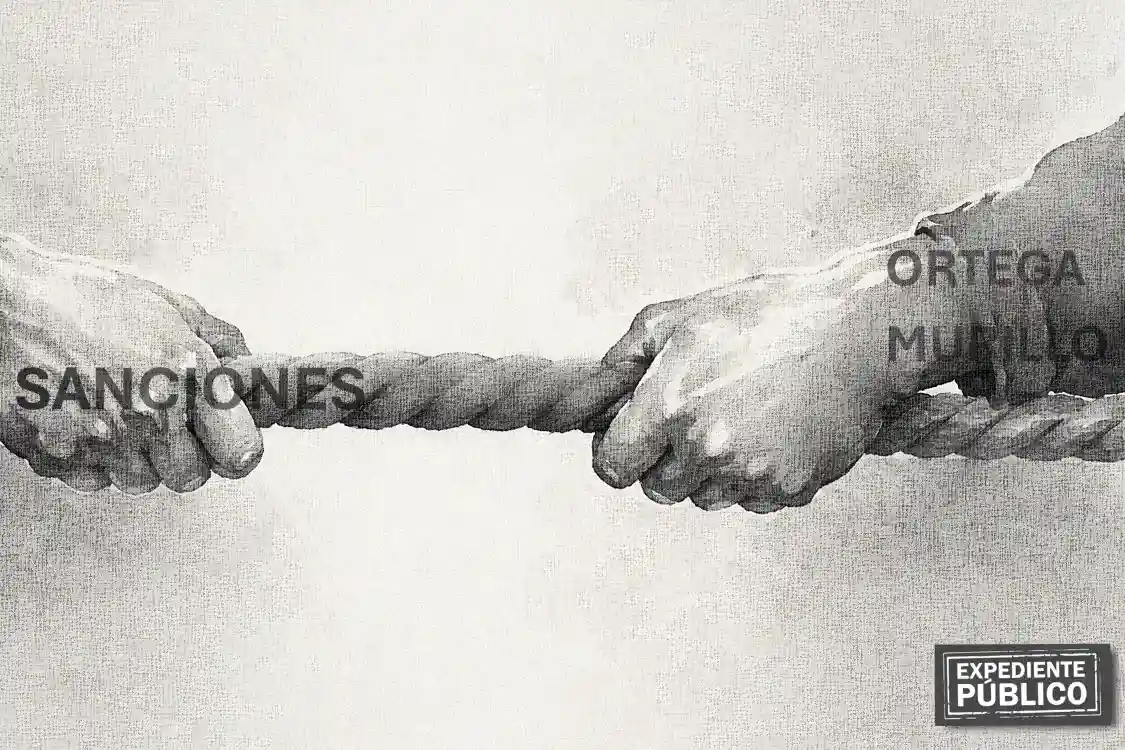
Previous reports show that this repression is not an isolated phenomenon: the Ortega-Murillo regime has intensified since the 2018 protests, while Cuba maintains and adapts a system of religious control built over decades.
Tomás Guevara / Expediente Público / Washington
Cuba and Nicaragua account for the greatest religious persecution in Latin America; unlike other parts of the world, its regimes primarily through a model of bureaucratic and police repression targeting faith groups, according to the latest report from International Christian Concern (ICC) in its 2026 Global Persecution Index.
Unlike the mass attacks on Christians in Africa and Asia, anti-Christian violence in Latin America, though smaller in scale, demands urgent attention because it constitutes a systematic, state-driven pattern.
“Faith in Latin America has long been inseparable from the social fabric of daily life,” the study notes in its chapter on Latin America and the Caribbean, explaining that Christianization over the last 500 years has developed roots and shaped the region’s institutional culture, but today it is under siege.
Subscribe to the Public Record newsletter and receive more information
“From the Caribbean island of Cuba to Nicaragua, authoritarian governments have identified the Church not as an ally of civic life, but as a rival power that must be challenged. The gravest religious freedom crises in Latin America are unfolding under socialist and communist governments,” the report explains.
The report also singles out Daniel Ortega, among the figures restricting religious freedom, as a key link in the persecution of Christians within the Central American country.
Read: The Ortega-Murillo dictatorship marked its anniversary isolated from the world
Cuba and Nicaragua: Repressive Models Against Faith in the Americas
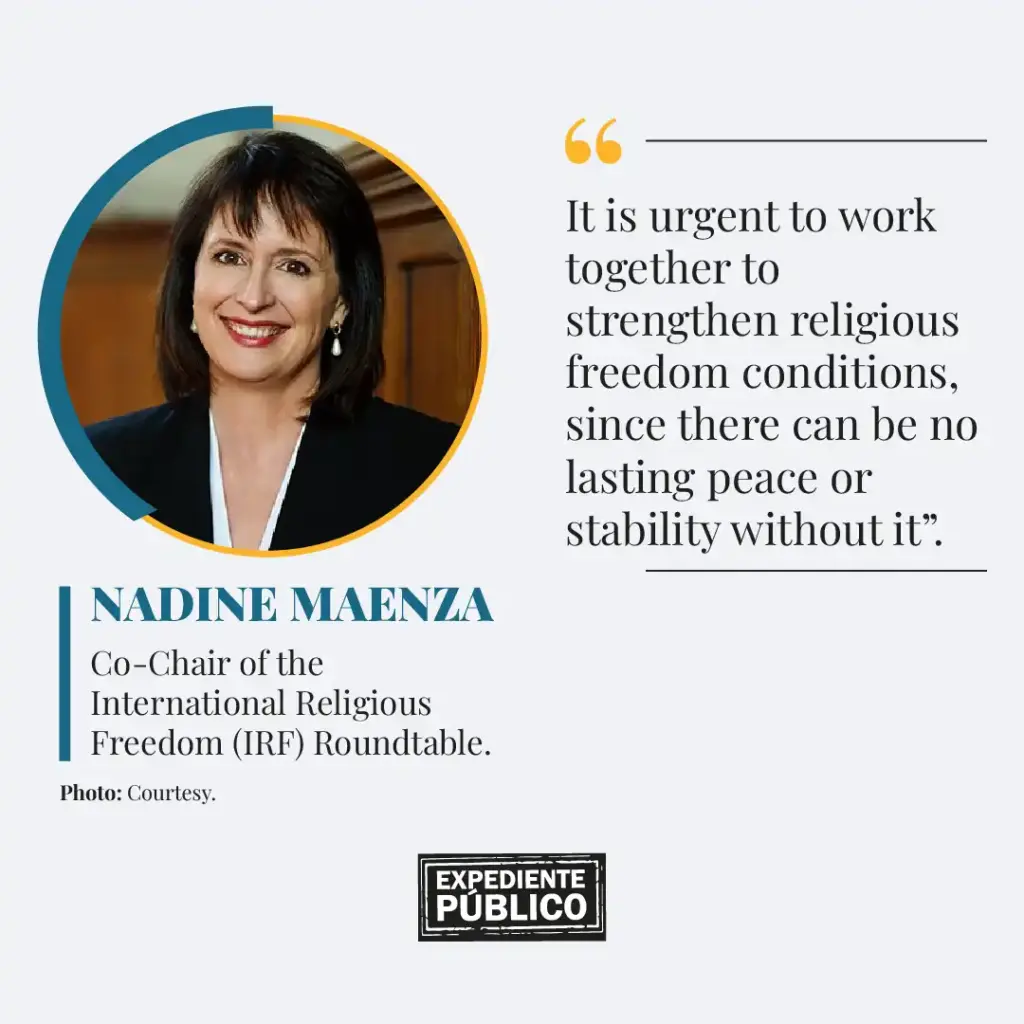
Nadine Maenza, co-chair of the International Religious Freedom (IRF) Roundtable and former chair of the U.S. Commission on International Religious Freedom, explains that the study’s results identify where the highest-concern hotspots lie on a global scale.
They also help build understanding of the “complex realities of each region,” including the countries and Christian communities facing the most adverse conditions.
“It is urgent to work together to strengthen religious freedom conditions, both in these countries and globally, since there can be no lasting peace or stability without it,” she notes.
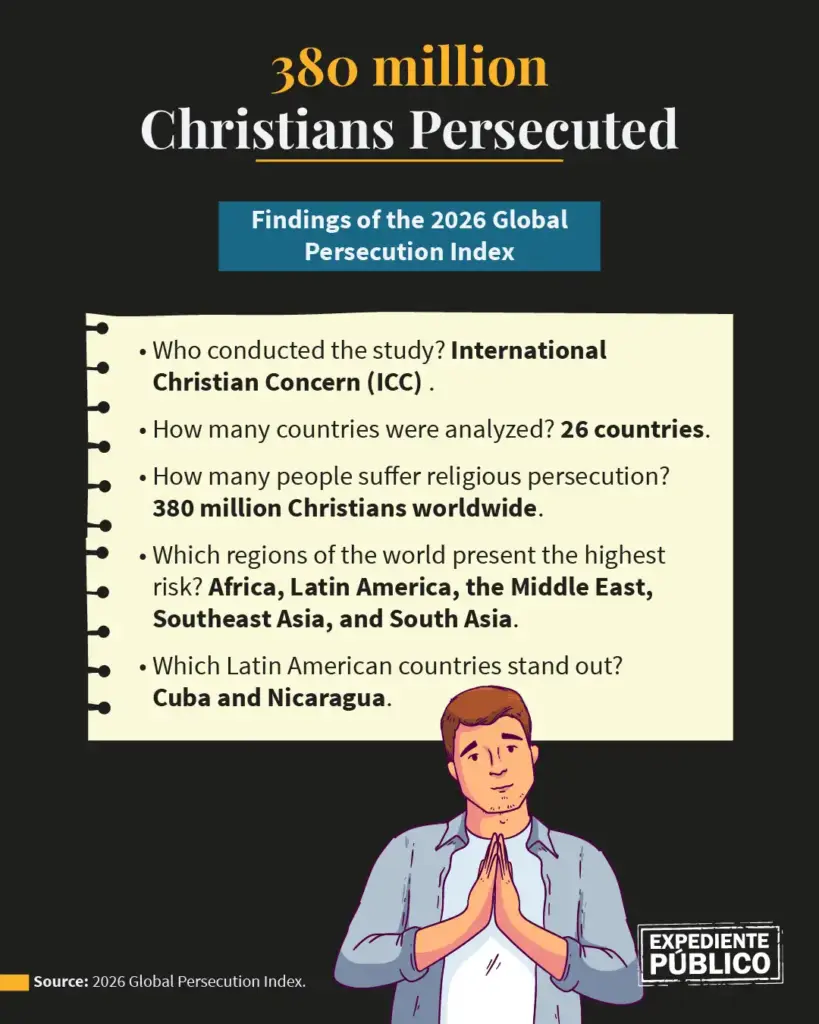
ICC is a Washington-based organization that has tracked persecuted Christian communities around the world since 1995, with a mission to defend faith, raise awareness, and provideassistance in hostile settings.
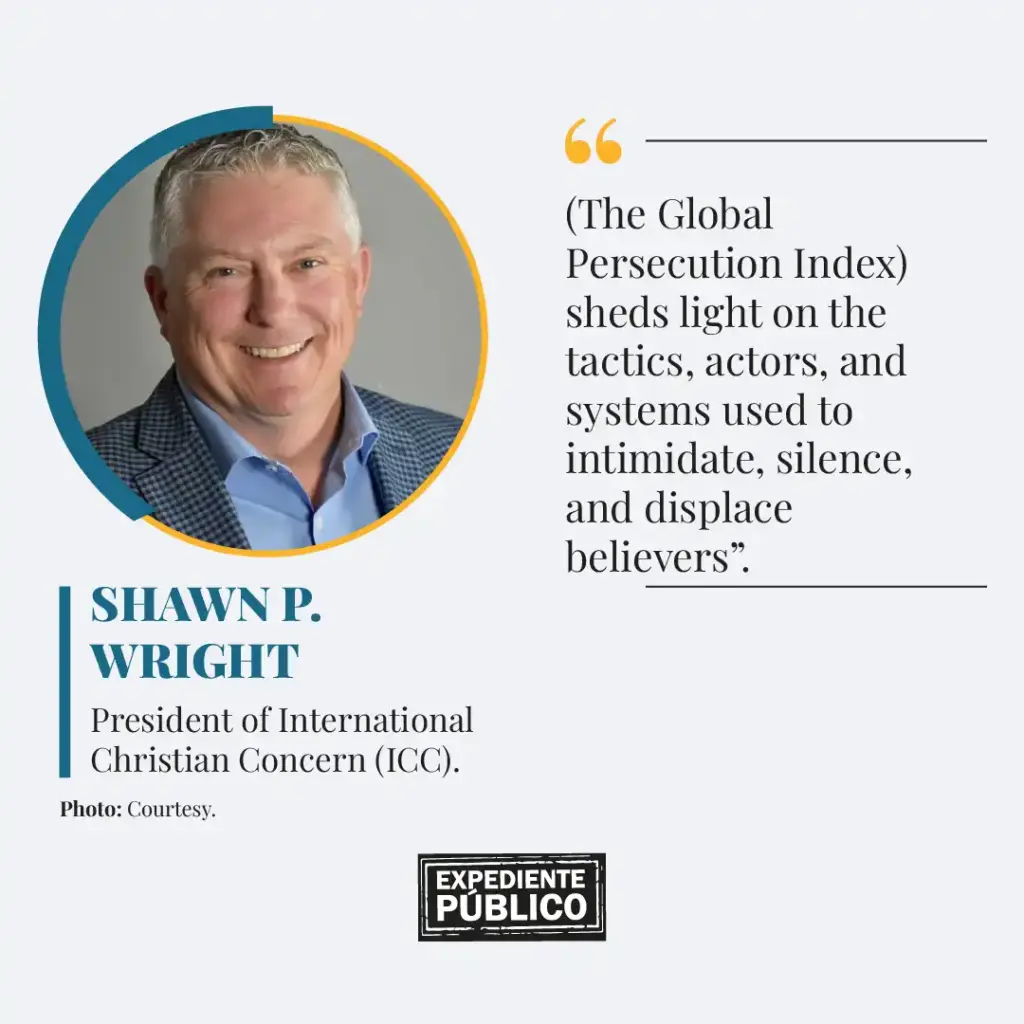
Shawn P. Wright, president of International Christian Concern, tells Expediente Público that the organization’s methodology includedtracking 26 countries where repression against Christian communities is most severe, while also spotlighting the individuals leading religious persecution.
“This combines country-level research, first-hand testimonies, reports from partner organizations, human rights documentation, religious freedom analysis, and ongoing monitoring by ICC researchers. The goal isn’t just to identify incidents, but also to observe and understand the patterns,” Wright explains.
Nicaragua: Believers Under Siege
The report describes Nicaragua as the most aggressive case of religious repression in Latin America. The dictatorship of Daniel Ortega and Rosario Murillo has imprisoned and expelled priests and evangelical pastors from the country, banned processions, closed religious universities, and revoked the legal status of church-affiliated organizations.
Records in the 2026 Index show that Nicaragua’s Ministry of the Interior has revoked the registration of more than 5,000 non-governmental organizations.
“In a mass purge carried out in a single day in August 2024, the Ministry declared 1,500 non-governmental organizations illegal, many of them religious in nature. The government also frequently confiscates these organizations’ assets and imprisons or exiles their leaders,” the report states.
Also: How the Ortega-Murillo dictatorship uses the Immigration Authority to repress
The State Department’s 2025 report on Religious Freedom also warned of the Central American country’s deterioration under a regime that increasingly seeks to stifle dissent through direct attacks on the Church.
According to the State Department, the Ortega-Murillo regime in Nicaragua “has harassed, detained, prosecuted, and deported numerous members of the Catholic clergy, the country’s largest religious community,” resorting to intimidation and manipulation to force several Church leaders into exile.
This is compounded by attacks targeting Catholic churches in Managua and other cities across the country.
“The tragedy of religious freedom in Nicaragua does not lie in the intimidation, detentions, or deportations; rather, it lies in the tragic shortsightedness of a government that lacks the moral courage to allow accountability to its own people or to respect a right as fundamental as freedom of religion or belief,” the State Department report noted.
ICC’s monitoring estimates that the deterioration and persecution in Nicaragua began with the 2018 protests, when several Catholic churches sheltered and assisted injured demonstrators.
Since then, the regime has treated much of the clergy as political opposition, and the persecution has expanded to sectors of the Evangelical Church as well.
Nicaragua was added to the U.S. Special Watch List as religious repression progressively worsened starting in 2020; since then, the U.S. has designated it a Country of Particular Concern, a category reserved for countries with severe religious freedom violations.
Worrying Differences
Based on the 2026 Index data, ICC’s greatest concern is that religious persecution is becoming globalized — what was once confined to a given territory now increasingly extends beyond national borders.
“They highlight the rise of transnational repression, as regimes increasingly surveil, intimidate, kidnap, or pressure” religious leaders or faith communities even after they have fled abroad.
The changes observed over the past year also indicate a rise in emerging threats “stemming from the convergence of various forces,” such as the use of digital technologies to identify and repress believers, along with a growing number of governments that are restricting religious expression.
ICC emphasizes that its comparative databases also draw on other official sources from democratic governments and international bodies, in addition to observations from its own in-country monitors, allowing for a complete picture of the landscape.
The report includes “updated incident reports, legal analysis, ICC field perspectives, and new documentation on attacks, displacement, detentions, and restrictions affecting persecuted Christians worldwide,” the center notes in outlining what’s new this year.
A World in Trouble
The 2026 Global Persecution Index estimates that roughly 380 million Christians suffer persecution worldwide, and it focuses particular attention on Africa, Latin America, the Middle East, and South and Southeast Asia as focal points for raising the alarm.
Globally, trends in religious persecution are rising alongside terrorist groups such as the Islamic State and other jihadist movements, with authoritarianism repeating itself as a common pattern across several regions of the world.
In Africa, for example, the deadliest threat comes primarily from non-state actors such as Boko Haram, a jihadist fundamentalist movement founded in Nigeria in 2002.
Amnesty International reports that Boko Haram is made up of several factions that sometimes collaborate with one another and at other times clash, and that it carries out extermination campaigns against communities that do not share its political, military, and religious objectives.
In other regions such as Afghanistan, Iran, China, and Vietnam, among others, religious persecution stems from restrictive laws, imprisonment, surveillance, and the subordination of religion to state power. In Iran, for example, religious autonomy and moral criticism are interpreted as political threats.
From that perspective, the report suggests, Nicaragua and Cuba are moving toward that same model, much like China and Vietnam, where both governments force religious organizations to operate within state-authorized structures.
The report also details that in these autocracies, religious persecution is not framed as a direct attempt to eradicate Christianity, but rather as a form of control over religious leadership meant to limit public presence and punish leaders who question or criticize state officials and their policies.
The Advance of a Regional Authoritarian Model
Cuba is a case in point, where religious organizations must register with the Office of Religious Affairs for oversight by the state apparatus, which includes every kind of permit required to hold services, repair places of worship, and carry out social activities.
ICC cites data from Christian Solidarity Worldwide that in 2024, the Cuban regime conducted 1,898 represeive measures against religious groups.
Also: Cuba, Nicaragua, and Venezuela on the U.S. blacklist for human trafficking
2025 to 2026 Report: Major Changes
Unlike ICC’s 2025 Global Index, this year’s methodology includes a substantial change, introducing a format that visualizes the regions, countries, and leading figures behind attacks on religious groups.
This year, ICC is paying closer attention to Latin America, including Cuba and Nicaragua.n previous editions appeared only as “areas of concern” and were left out of the global picture of repression against Christian crchurches.
Shawn Wright, ICC’s president, says the methodology changes aim to identify every link to the repressive structures that target churches and the scale of that repression.
“We want to see whether the persecution is being carried out by governments, extremist groups, criminal organizations, nationalist movements, non-state actors — that’s a major issue that has been a focus here in recent years — or by social pressures,” he notes.
This year’s report design covers six regions and 26 countries, and also highlights the figures behind the waves of repression: among them Daniel Ortega, head of the Sandinista dictatorship; Nigerian President Bola Ahmed Tinubu; Syria’s interim president, Ahmed Al-Sharaa; and India’s president, Narendra Modi, all identified as directing systematic actions against Christian believers.
The special designations given to Cuba and Nicaragua in the 2026 report, with detailed chapters covering figures, processes, and testimonies, highlight the context in both Latin American nations.
This also reflects a deliberate effort to highlight a regional problem that human rights organizations have been documenting and denouncing for decades in Cuba and for eight years in Nicaragua.
Another new feature of the 2026 edition is a first-of-its-kind section titled “Hindrances to Religious Freedom in the West,” a watch area that documents restrictions on religious practice in Western countries — from local laws limiting the public expression of faith to legal proceedings or workplace sanctions on religious grounds.
“While Christians in Western nations don’t experience the same horrific persecution that believers in other hot spots face, religious freedom in corners of the West is eroding,” ICC warns.
The report documents, for example, the case of a teacher in England who was banned from working with children after telling a Muslim student that England was still a Christian nation — a sanction he later won on appeal — as well as the case against Finnish parliamentarian Päivi Räsänen, charged with hate speech after questioning on social media the Lutheran Church’s support for a pride parade. The report also points to growing Islamization in Europe as a factor that, according to ICC, is putting pressure on the public space historically occupied by Christianity.
The Cuban Repressive Model Is Being Replicated
Persecution in the Americas relies on distinctly repressive tools. The Latin American experience is far removed from the bloodier forms of persecution seen elsewhere in the world, but it does reveal a structured way of operating.
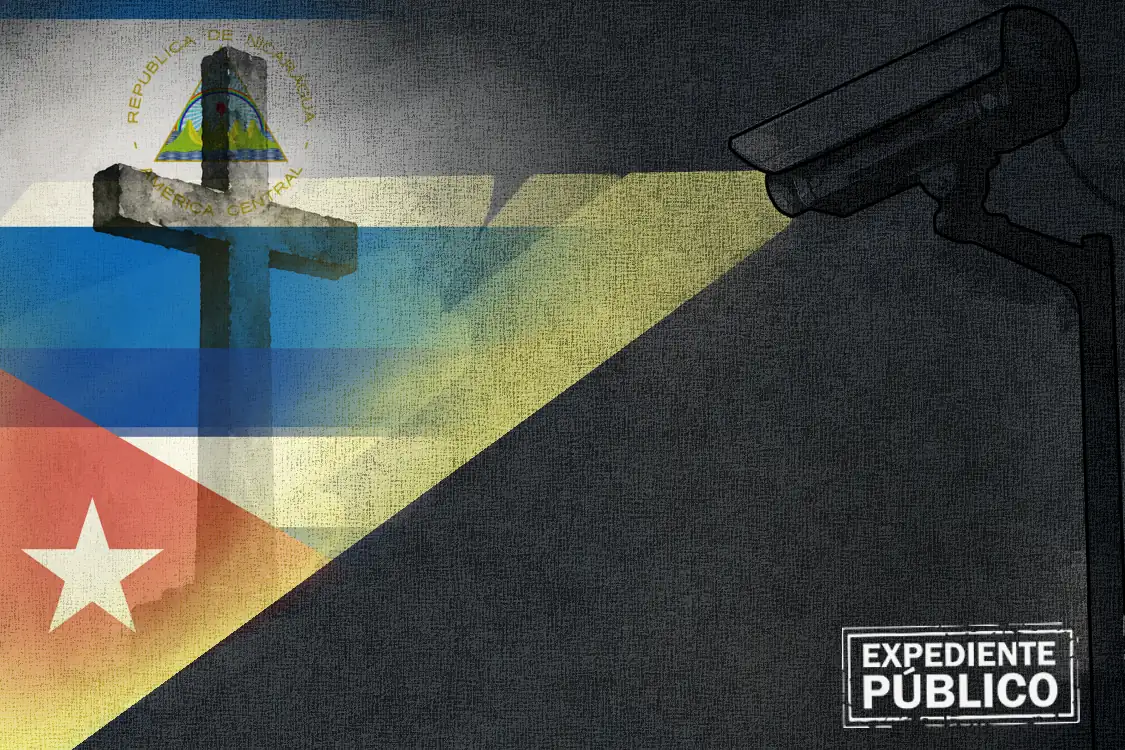
While extremist groups in Africa and Asia seek to expel or exterminate communities, Cuba and Nicaragua rely on registration requirements, confiscations, surveillance, exile, imprisonment, and control over education.
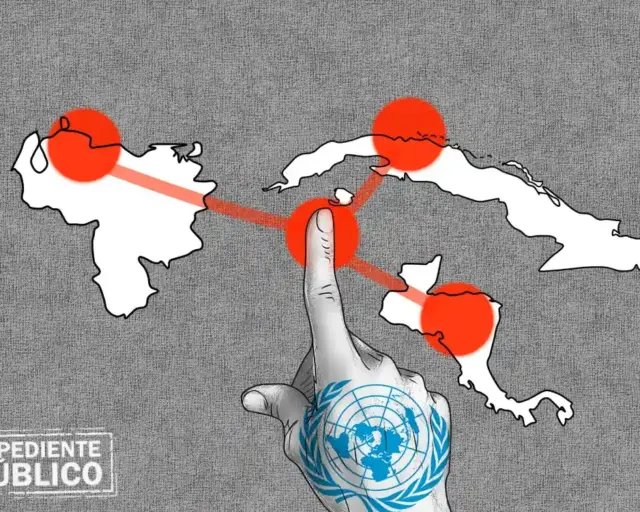
The findings of the 2026 Index further confirm a trend already seen in the Cuban model of religious subordination, one that appears to be replicating, with slight variations, in Nicaragua and Venezuela.
The three governments are widely regarded by the international community as an “authoritarian triad” that uses state institutions, ambiguous legislation, and security services to restrict freedom of religion or belief.
As a result, the Latin American countries highlighted in the report show two different speeds: on one hand, the Cuban regimealready has a system of control consolidated over decades.
The regime in Nicaragua, meanwhile, is accelerating and expanding its repressive apparatuses to eliminate, in as short a time as possible, all the remaining independent spaces that hold social influence within the Central American country.
This article was translated into English with the assistance of artificial intelligence and was reviewed and edited by a human editor.